Pesquisar este blog

Translate

sexta-feira, 12 de abril de 2013

Nanosilver in textiles – friend or foe?


Antimicrobial silver nanoparticles may enable people to use textiles in an environmentally more sustainable way, even though a question mark remains on their potential risks
Silver has been used as biocide for medical purposes since the 1930s. Today nanometric size silver particles are used to prevent unpleasant odour caused by bacteria in sport shirts or socks. “Nanosilver can be applied in lower quantities than other antimicrobials and hence has advantages regarding resource use and environmental loads”, Tobias Walser tells youris.com. He is a researcher at the Institute for environmental engineering at the Swiss Federal Institute of Technology in Zürich. However, “the environmental and human risk of nanosilver has yet to be fully understood“, he adds.
As part of an EU funded project called Prosuite, Walser and colleagues analysed the environmental impact of nanosilver T-shirts during their entire life cycle, from raw material extraction to end-of-life disposal. This, according to Walser, is the first of its kind for a nanomaterial. The scientists found that the T-shirt’s environmental impact during use would be reduced if they are washed less often than conventional ones, due to their antimicrobial properties. This would even compensate for a slightly higher climate footprint during production. Walser explains: “In comparison to all toxic releases during the life cycle of a T-shirt, the toxic releases from nanosilver from washing appear to be of minor relevance.”
Previous studies looked at single impacts of antibacterial textiles. For example, scientists found that nanosilver leaches into the wastewater during washing. According to other studies, this silver may not be that harmful to the environment because it is transformed into a nearly insoluble substance called silver sulphide in wastewater treatments. A study published by the Danish Environmental Protection Agency in 2012 did not find “specific risks” to health or environmental effects of nanosilver textiles available in Denmark.
“The [Prosuite] study is an important step into the right direction,” comments Bernd Nowack, an expert in environmental risk assessment at Empa, the Swiss Federal Laboratories for Materials Science and Technology. Yet, to be able to fully assess the environmental benefits of nanosilver textiles, more should be known about issues such as the industrial production of nanosilver or whether the textiles are actually washed less often. Nowack regards nanosilver as an effective biocide, with little drawbacks. “There is no strong evidence for the toxicity of nanosilver”, he adds. 
Some experts are concerned about their environmental risks, however. The study “is very relevant” because it “gives a fingerprint” about the impact of such T-shirts, Anders Baunsays. But the professor in risk assessment of nanomaterials at the department of environmental engineering at the Technical University of Denmark, based in Lyngby,considers it “a bad idea to distribute silver in the environment”. He points to a study that found evidence for nanosilver accumulating in the food web based on a study of plants and animals of an experimental wetland environment. Moreover, he says, it is unknown how the coating of nanosilver influences its environmental behaviour. Baun has previously criticised the European policies regarding nanosilver and is currently enrolled in a scientific committee on the topic as invited expert. The expert group will publish its opinion later this year, he says.
Another issue is that bacteria may become resistant to silver if it is widely used in consumer products. “This is a threat for medical applications”, Hans-Curt Flemmingtells youris.com. The Professor of aquatic microbiology at the University of Duisburg-Essen, in Germany, contends that nanosilver in consumer textiles is “plain nonsense”.
Walser, currently a visiting scientist at the U.S. Environmental Protection Agency, is now collecting data and conducting modelling studies on nanoparticle emissions in productions sites to improve the life cycle assessment of nanotextiles. While there is no threat to people using such textiles, this is probably different for workers in the nanotechnology industry who may inhale the particles, Walser says. “The nanoparticles can penetrate deeply into the lung” and inhalation therefore remains “the critical pathway”.

quinta-feira, 11 de abril de 2013

Brasileiros e portugueses desdobram parceria em nanotecnologia


A colaboração luso-brasileira em nanotecnologia deve avançar por novos rumos após um seminário que ocorre segunda (15) e terça-feira (16), no Laboratório Ibérico Internacional de Nanotecnologia (INL), em Braga. O evento integra a programação do Ano do Brasil em Portugal e tem participação de dirigentes do Ministério da Ciência, Tecnologia e Inovação (MCTI). 


Representantes de governo, pesquisadores e empresários dos dois países têm como principal tarefa desenhar os próximos passos de programa lançado pela Coordenação de Aperfeiçoamento de Pessoal de Nível Superior (Capes/MEC) em parceria com o INL, em março, quando o ministro português da Educação e Ciência, Nuno Crato, esteve em Brasília. Na ocasião, o presidente da Capes, Jorge Guimarães, assinou o Edital 15/2013, que garante acesso de instituições de ciência e tecnologia (ICTs) ao laboratório ibérico.

O programa entre Capes e INL busca estimular a realização de projetos conjuntos de pesquisa em nanotecnologia, a partir da capacidade instalada, dos recursos humanos e da infraestrutura disponível na instituição europeia. O documento já lançado previa a realização do seminário, que deve originar um edital complementar, a ser publicado em maio, com maior detalhamento do acordo, como áreas de interesse da cooperação e valores a investir.


Em Braga, representam o MCTI nas discussões o secretário adjunto de Desenvolvimento Tecnológico e Inovação, Adalberto Fazzio, o coordenador-geral de Micro e Nanotecnologias, Flávio Plentz, e a chefe interina da Assessoria de Assuntos Internacionais da pasta, Bárbara Sant’Anna.*

Fazzio deve abordar as políticas brasileiras para o setor, e Plentz, o Sistema Nacional de Laboratórios em Nanotecnologias (SisNano) – rede elaborada pelo MCTI para estruturar e ampliar o acesso de cientistas e empresas à infraestrutura de pesquisa básica e avançada com matérias de tamanho atômico.
Também integram a delegação o diretor do Laboratório Nacional de Nanotecnologia (LNNano), Fernando Galembeck, e os pesquisadores Rubem Sommer, do Centro Brasileiro de Pesquisas Físicas (CBPF/MCTI), e Carlos Buffon, do LNNano, além de representantes de oito universidades e da Confederação Nacional das Indústrias (CNI), já que o programa da Capes propõe o envolvimento de empresas e estudantes brasileiros.

Ano do Brasil em Portugal
O seminário de nanotecnologia faz parte de uma série de eventos iniciada na segunda-feira (8), quando brasileiros e portugueses se encontraram em Lisboa para um diálogo sobre inovação. Os coordenadores-gerais de Inovação Tecnológica, Reinaldo Danna, e de Serviços Tecnológicos, Jorge Campagnolo, participaram das discussões em busca de um programa de trabalho bilateral.
A agenda continua com o Seminário de Tecnologias em Energia, quinta (18) e sexta-feira (19), no Laboratório Nacional de Energia e Geologia (LNEG), em Lisboa. Pelo MCTI, os coordenadores de Desenvolvimento de Tecnologias Setoriais, Eduardo Soriano, e de Ações de Desenvolvimento Energético, Rafael Menezes, comparecem aos debates e fazem visitas técnicas a instituições.

Texto: Rodrigo PdGuerra – Ascom do MCTI
(atualizado em 11/04/2013)
______________________________________________

* Conforme informações da analista do MCTI, Francine Barbosa, somente o Coordenador-geral está em Portugal. (16/04/13)

quarta-feira, 10 de abril de 2013

Conselho discute tecnologia popular para avaliar potabilidade da água


Desenvolver um nanossensor popular capaz de detectar, ao mesmo tempo, a presença de três poluentes na água: Escherichia coli (bactéria responsável por graves problemas intestinais), metais pesados e glifosato (herbicida). O desafio foi aceito pela Comissão de Tecnologias Sociais do Conselho Nacional de Ciência e Tecnologia (CCT), que se reuniu nesta terça-feira (9), em Brasília.

O encontro – realizado no Centro de Gestão e Estudos Estratégicos (CGEE) – reuniu especialistas nas áreas de física, química, biologia e gestão pública e contou com a presença do coordenador-geral de Micro e Nanotecnologias do Ministério da Ciência, Tecnologia e Inovação (MCTI), Flavio Plentz, dos assessores especiais do ministério Adalberto Fazzio e Ana Lúcia Gabas e do assessor técnico do CGEE Elyas Medeiros.

O grupo, coordenado pelo vice-presidente da Sociedade Brasileira para o Progresso da Ciência, Ennio Candotti, tem se dedicado ao desenvolvimento de um dispositivo barato e de simples operação para a população em geral capaz de sinalizar se a água é potável. 

Na reunião, laboratórios de nanotecnologia apresentaram técnicas possíveis para o desenvolvimento de dispositivos para detectar bactérias ou elementos poluentes.


Ao falar sobre os progressos alcançados pelo Departamento de Física da Universidade Federal de Pernambuco (Ufpe) com o tema “Polímeros condutores e potabilidade”, o professor Celso Pinto de Melo ressaltou a importância da iniciativa ao lembrar o caso da população brasileira que é castigada pela seca e, muitas vezes, anda quilômetros para conseguir um pouco de água sem saber a qualidade do que vai encontrar e consumir. “Um dos fatos que provocou esse programa foi imaginar de que a Amazônia é um ‘mar de água’ e que não é potável. A população ribeirinha também não sabe se pode beber a água”, concordou Candotti.

Tema em foco
O professor Jailson Bittencourt Andrade, do Departamento de Química Geral e Inorgânica da Universidade Federal da Bahia (Ufba), destacou as peculiaridades de cada região no que se refere às problemáticas relacionadas à potabilidade da água. “Não é uma fonte pontual, mas difusa”, disse. Bittencourt lembrou também que a ação do CCT vai ao encontro do Ano Internacional de Cooperação pela Água (2013), lançado pela Unesco. “Muitas crianças no mundo morrem por doenças transmitidas por meio da água”, alertou.


Ele recordou, ainda, uma ação desenvolvida mundialmente pelo Ano Internacional da Química (2011), em que foi realizado o Experimento Global do pH do planeta. Com a distribuição de milhares de kits para escolas, alunos coletaram amostras de água provenientes de fontes naturais locais e puderam medir a acidez com o uso de soluções coloridas indicadoras. “O Brasil foi responsável por 28% dos experimentos. É um exemplo de como podemos mobilizar a população e as escolas”, afirmou.

Em sua explanação sobre o uso de nanomateriais para Aplicação em Medicina e Controle Ambiental, o professor Valtencir Zucolotto, do Laboratório de Nanomedicina e Nanotoxicologia do Instituto de Física da Universidade de São Paulo (USP-São Carlos) tratou sobre o uso de nanomateriais para aplicações na área de medicina e de controle ambiental.
“A medicina está muito interessada em nanotecnologia, um exemplo é o uso de nanopartículas para o diagnóstico mais preciso de tumores”, disse Zucolotto, ao descrever os trabalhos desenvolvidos, nos últimos anos, na produção de nanossensores para a detecção de doenças infecciosas, como a leshimaniose, e de membranas celulares para a remoção de metais pesados de águas fluviais.

O pesquisador Carlos César Bufon, do Laboratório Nacional de Nanotecnologia do Centro Nacional de Pesquisa em Energia e Materiais (CNPEM), apresentou as aplicações possíveis de sensores nanoestruturados para avaliar a qualidade de resíduos industriais em águas de rios e lagos e do nível de contaminação da água por contaminantes biológicos, metais pesados e defensivos agrícolas.

Também participaram do encontro uma representante da Agência Nacional de Águas (ANA/MMA), Mariana Gomes, que fez um panorama sobre a legislação existente sobre a potabilidade da água e os principais desafios na área, e a pesquisadora Sofia Luíza Brito, da Fundação Centro Internacional de Educação, Capacitação e Pesquisa Aplicada em Águas (Unesco-HidroEX), que relatou o trabalho realizado para avaliar a qualidade da água no município de Frutal (MG).

Programa
Adalberto Fazzio e Flavio Plentz informaram que a criação de nanossistemas para diagnósticos faz parte de um programa maior e específico para a área de nanotecnologia que vem sendo construído no âmbito do MCTI nos últimos dois anos. “É essencial termos ações desse tipo para induzirmos projetos específicos”, frisou Plentz, ao comentar a importância da discussão.

O coordenador da área de nanotecnologia do ministério explanou sobre iniciativas já implantadas para impulsionar o setor, a exemplo do Sistema Nacional de Laboratórios em Nanotecnologias (SisNano) e do Comitê Interministerial de Nanotecnologia (CIN). Plentz trouxe ao grupo a preocupação em debate no comitê de se promover a integração orçamentária entre vários ministérios. “Essa ação, que deve ser importante e inclusiva, é uma discussão técnica e longa e que vai envolver diversos atores”, frisou.

Segundo Ennio Candotti, as considerações do grupo e o resultado dos trabalhos serão encaminhados ao comitê interministerial. “Esse é um bom pretexto para se colocar na mesa a importância da nanotecnologia e existe um compromisso do ministério em relação a essa política”, finalizou.

Texto: Denise Coelho – Ascom do MCTI

segunda-feira, 8 de abril de 2013

Seemingly Small Research Funding Cuts Could Hinder Progress in Nanotechnology

Cuts in federal funding of nanotechnology research threaten to slow progress toward some of the field's greatest promises, including commercialization of sustainable new energy sources that do not contribute to global warming, an international authority in the field cautioned here today.


Speaking at the 245th National Meeting & Exposition of the American Chemical Society, the world's largest scientific society, A. Paul Alivisatos, Ph.D., expressed concern that the cuts come when nanotechnology is poised to deliver on those promises. He told the meeting, which continues through Thursday, that ill-conceived cuts could set back America's progress in nanotechnology by decades.
"The National Science Foundation announced that they will issue a thousand fewer new grants this year because of sequestration," said Alivisatos, referring to the across-the-board mandatory federal budget cuts that took effect on March 1. "What it means in practice is that an entire generation of early career scientists, some of our brightest and most promising scientists, will not have the funding to launch their careers and begin research properly, in the pathway that has established the United States as leader in nanotechnology research. It will be a setback, perhaps quite serious, for our international competitiveness in this key field."
Alivisatos described applications of nanotechnology that can help reduce fossil fuel consumption and the accompanying emissions of carbon dioxide, the main greenhouse gas. He is professor of chemistry and materials science and the Larry and Diane Bock Professor of Nanotechnology at the University of California at Berkeley, director of the Lawrence Berkeley National Laboratory and co-editor of the ACS journalNano Letters. Nanoparticles of various substances already have been incorporated into solar panels, rechargeable batteries and other clean-energy solutions. These particles are so small that 1,000 to 100,000 could fit across the width of a human hair. When size diminishes to that scale, gold, silver, copper and other substances take on physical properties vastly different from lumps of bulk material.
Although nanotechnology remains a science in its infancy, it already has had a major impact on many other industrial segments, ranging from consumer products to national security and defense. By one estimate, more than 600 nanotechnology-enabled consumer products already are on the market, including mobile phones, cosmetics, music systems and clothing. Forecasts suggest that the global market for such products will increase by more than 10 percent annually in the years ahead.
Alivisatos expressed concern, however, that cuts in federal funding will take a heavy toll on the still-emerging field. He explained that the reductions stand to affect scientists at almost every stage of making contributions to society. Young scientists, for instance, will find it more difficult to launch research programs in new and promising fields. Established scientists will have to trim research programs, and may not have the money to explore promising new leads.
"We haven't been able to communicate adequately with the public and policymakers, and explain the impact of what may sound like small and unimportant cuts in funding." Alivisatos said. "A 5 percent reduction in funding -- well, to the public, it seems like nothing. In reality, these cuts will be applied in ways that do maximal damage to our ability to be globally competitive in the future."
In his talk, Alivisatos highlighted some of nanotechnology's successes in reducing the amount of carbon humans are adding to the atmosphere. For example, lithium iron phosphate batteries, a type of rechargeable lithium-ion battery, are being used in vehicles, electronics and the solar-powered pathway lamps often seen in yards and gardens. These batteries rely on nanoparticles to safely store and release energy. Similar rechargeable batteries might be part of future "smart" electrical grids that use electricity more efficiently, reducing the amount of fossil fuels power companies must burn.
Another promising field is the conversion of natural gas -- the supply of which has burgeoned in recent years with advances in hydraulic fracturing, or "fracking," techniques -- to liquid petroleum products. Natural gas is widely seen as a cleaner energy source than other fossil fuels like coal and petroleum. Alivisatos described nanoparticle-based technologies that promise to improve existing conversion processes.

sábado, 6 de abril de 2013

Risks of nanomaterials under the microscope


Image source: Bayer AG
Nanotechnology is continually increasing in terms of research, economic and social significance. However, working with synthetic nanomaterials also conceals risks. 
Empa has produced a study for the Federal Office for the Environment (Bundesamt für Umwelt, BAFU) in order to clarify whether special regulations should be incorporated into the Federal Hazardous Incident Ordinance with regard to human and ecotoxicity. The conclusion, based on present knowledge, was this: At present, the safety measures for chemicals are also sufficient for synthetic nanomaterials.

Cover Human and Ecotoxicity of Synthetic NanomaterialsSynthetic nanomaterials are already manufactured and processed in Switzerland in various plants. It is therefore essential that, as well as identifying opportunities, potential risks to humans and the environment are detected at an early stage and, if necessary, appropriate preventative measures are implemented. Within the scope of the federal government’s action plan to establish principles for safe nano-technology, Empa evaluated whether special regulations need to be incorporated into the Hazardous Incident Ordinance, on account of the potential danger and various hazardous incident scenarios. The objective of the Hazardous Incident Ordinance is to protect the population and the environment from serious damage caused by extraordinary events. To this end, researchers visited the Empa “Technology and Society” and “Materials Biology Interactions” departments of several companies that process synthetic nanomaterials, analysed data from human toxicological and ecotoxicological studies and backed up their findings with their own experience and experiments in the field of nanotechnology. The report entitled, “Human and Ecotoxicity of Synthetic Nanomaterials – Initial Insights for Major Accident Prevention” has now been published by BAFU.

Tried and tested methods still sufficientThe document, approximately 40 pages in length, analyses various synthetic nanomaterials and summarises the various international guidelines and research findings. In Switzerland, according to an initial finding from the study, the manufactured and processed quantities of synthetic nanomaterials are small. The existing safety measures in place within the chemical industry are also sufficient for synthetic nanomaterials and, according to the report, additional protective measures for nanomaterials are not necessary. Risks when working with nanomaterials in powder form could, for example, be minimised through safety measures in place when working with standard dusts. However, it is essential that the manufacturers of nanomaterials fulfil their obligation to create a safety datasheet and provide the necessary information for the classification of materials.
Further research is urgently required
Finally, the Empa team analysed the (acute) risks to people, animals and the environment in the event of an accident. According to initial findings there is currently no need to incorporate specific regulations for nanomaterials in the area of human and ecotoxicity into the Hazardous Incident Ordinance. As such, the evaluations of the Empa researchers have no relevance to occupational safety. The Hazardous Incident Ordinance only considers persons outside the business premises, with one-off exposure – chronic effects, for example as can be caused by long-term exposure in the workplace, are excluded. It is therefore essential to know more, in particular when it comes to these chronic risks. Further research and, first and foremost, detailed guidelines and a definition of the topic of synthetic nanomaterials are essential according to the report.
At present there is no need for action with regard to possible “nano accidents” in Switzerland is the report’s conclusion. However, it is important that we always bear current findings from research and the world of industry in mind and conduct regular checks as to whether the statements mentioned in the report are in keeping with the latest technical advances.

Literature reference
«Human and Ecotoxicity of Synthetic Nanomaterials», Bundesamt für Umwelt BAFU

Fonte: EMPA

Study says risk of nanotechnology in food chain is 'negligible'

Study says risk of nanotechnology in food chain is 'negligible'


By Martin Banks - 

 It is clear from what we have been told at this debate that the risk [from nanotech in food] is negligible and that is clearly good to hear
Vittorio Prodi
 The scare stories about nanotechnology illustrates the instinctive shock-horror reaction of the green lobby
Roger Helmer
A new study has played down the potential risks arising from nanoscience and nanotechnologies used in the food chain.

The study, commissioned by PlasticsEurope, said that the risk of nano materials 'migrating' to plastics packaging and food was "negligible".

The results were published at a debate in parliament on Tuesday, co-organised by Plastics Europe and The Parliament Magazine.

While nanotechnology is already widely employed - in applications ranging from odour-free socks to novel cancer therapeutic methods - they have long been regarded as a subject requiring further study to ensure their safety.

This was the spur for PlasticsEurope, the Brussels-based association of plastics manufacturers, to commission the study.

The exhaustive exercise was conducted by Roland Franz, who heads the department of product safety and chemical analysis at the Fraunhofer IVV institute, based in Germany.
Franz, who also serves as a scientific expert on food issues to the European commission, said that after much research he had concluded that the risk of migration was "very low" and that nanomaterials in food packaging are "safe and convenient" for consumers.He said, "There is no evidence of any migration, even under the most severe of test conditions." His study, he added, had also showed that a more "risk based" approach to safety research would offer more clarity than labelling alone.
Italian deputy Vittorio Prodi, of the S&D group and one of several MEPs who took part in the debate, said the event had highlighted the "importance" of having "reliable, scientific" data on the potential contamination of nanotechnologies in the food chain.

He went on, "It is clear from what we have been told at this debate that the risk is negligible and that is clearly good to hear."

The event heard that the European food safety authority, in its 2009 opinion on the potential risks arising from nanoscience and nanotechnologies used in food, had recommended that action should be taken to generate more information on the properties of nanomaterials when they are exposed to consumers.

Prodi cautioned that research into the impact of nanomaterials in other non-food products such as cosmetics had yet to yield the same conclusive results.
He said, "I think we can be pretty sure about the food safety aspects in this but maybe less certain about other things."

However, another MEP, Roger Helmer, of the UK Independence Party, described the findings as "reassuring". 
Helmer, his party's spokesperson on energy affairs, added, "The scare stories about nanotechnology illustrates the instinctive shock-horror reaction of the green lobby to almost any new technology."

UB helps to launch two Zimbabwe national programs in nanotechnology and HIV/AIDS eradication


Photo of Zimbabwe fellows and family
Breakfast meeting with UB-UZ AITRP fellows and families and UB's Gene Morse, Robin DiFrancesco (both upper left), Kelly Tooley (AITRP Education and Operations Coordinator) and Amy Moss (current UB HIV Resident and AITRP Mentor). Dr. Maponga is left next to Dr. Morse.
Release Date: April 5, 2013
“The outcome created a new level of collaboration, reaching beyond university campuses to the highest levels of government ministries as well as community programs.”
Gene Morse, PharmD, professor
associate director of the UB Center of Excellence in Bioinformatics and Life Sciences head the UB-ZINC collaboration
Photo
Zimbabwe meeting fellows with Morse and Maponga
Zimbabwe fellows and families with Morse and Maponga
Downloads
BUFFALO, N.Y. -- What does it take to launch two major international HIV/AIDS research initiatives involving the University at Buffalo and the University of Zimbabwe?
It requires attention to issues as diverse as working with government officials, choosing the right scientists, establishing ethics in research, training for quality control and good laboratory practices, transferring paper patient records into electronic formats and understanding how different cultures respond to serious illness and treatment.
And it requires face-to-face information exchange and planning.
A UB-led research team recently traveled to Zimbabwe to participate in a week-long program of workshops that included the formal launch of two Zimbabwe national programs: the Zimbabwe International Nanotechnology Center (ZINC) and the Zimbabwe Evidence-To-Action (ETA), an implementation project to eradicate HIV/AIDS in Zimbabwe.
With 14 percent of Zimbabwe's population living with HIV/AIDS and tuberculosis as a co-infection, the need for new drugs and new formulations of available treatments is crucial.
UB’s role in the ZINC partnership is to provide training to young scientists and students in Zimbabwe in multiple areas within nanotechnology. The trip to Zimbabwe included identifying research areas of common interest to Zimbabwe and prioritizing them according to the country’s needs.
UB has built a partnership with Zimbabwe over seven years through an NIH Fogarty International Center program.
Paras Prasad, PhD, SUNY Distinguished Professor in the Departments of Chemistry, Physics, Medicine and Electrical Engineering; Samuel P. Capen Chair of Chemistry and executive director of UB’s Institute for Lasers, Photonics and Biophotonics (ILPB), and Gene Morse, PharmD, professor and associate director of the UB Center of Excellence in Bioinformatics and Life Sciences head the UB-ZINC collaboration.
“There was an incredible feeling of optimism and high energy toward both initiatives,” said Morse.
The week began with the second Zimbabwe National Nanotechnology Consultative Meeting on March 18 - 19.
Prasad, who will direct the international nanotechnology contributions for ZINC, gave the keynote address.
Morse, who will direct the international nanomedicine component of ZINC, presented the role that UB and the CoE will play in ZINC. Other participating UB faculty included Stanley Schwartz, MD, SUNY Distinguished Professor of Medicine and Peter Horvath, PhD, associate professor of exercise physiology and nutrition.
Background and details of ZINC were provided during presentations from the minister for science and technology development (MSTD), the Honorable Professor Heneri Dzinotyiweyi, UB alumnus, Chiedza Maponga, PharmD, technical director for nanotechnology (MSTD) and director of the UZ School of Pharmacy, and Josephat Zimba, Technical Consultant to the MSTD on nanotechnology. Additional presentations from Professor Levi Nyagura, UZ Vice Chancellor, and Professor David Simbi, CUT Vice Chancellor, described the leadership roles for their universities.
The week continued with a two-day workshop on March 20 - 21 for the ETA Project.
Hosted by the Ministry of Health and Child Welfare, the first day summarized:
·         Recent compelling data that provide the rationale for preventing HIV transmission through pre-exposure prophylaxis (PrEP) and treatment as prevention (TaSP)
·         The national statistics for prevention of mother-to-child transmission and pediatric HIV infection
·         HIV Prevention Trials Network (HPTN) 052 and the dramatic results obtained in discordant couples when the HIV-infected partner was treated early after infection leading to a reduced transmission rate
·         The need for a strategy to provide treatment to key populations with HIV infection including high risk groups such as prisoners, men who have sex with men, commercial sex workers and pregnant women.
At a concurrent workshop, Robin DiFrancesco, manager of the UB Clinical Pharmacology Quality Assurance Program (CPQA) and an AIDS International Training and Research Program (AITRP) mentor, provided lectures focused on building laboratory skills and bioanalytical method development.
In a second afternoon workshop, Kathleen Tooley, senior research support specialist in the UB Translational Pharmacology Research Core, and Education and Operations Administrator for CPQA and AITRP, and an AITRP mentor, moderated a group at the UZ College of Health Sciences to address challenges in research ethics and research administration for faculty and students who will conduct research within ETA.
Morse chaired the second day of the workshop and provided a presentation on the progress of the UB-UZ AITRP. Highlights included a review of the Training Advisory Group and the recently established Scientific Advisory Board, new research programs, nutritional and traditional medicine pharmacology, clinical pharmacology and healthcare informatics.
The second half of the morning program was chaired by Morse and focused on Bioinformatics and Health Information Technology (HIT) required for the ETA infrastructure in collaboration with the Zimbabwean health care system.
In the HIV Nutrition Pharmacology working group, Horvath and faculty and graduate students from the Departments of Pediatrics and Biochemistry discussed nutritional considerations for the ETA project.
Horvath also provided a seminar on March 25 for the UZ Departments of Pediatrics and Biochemistry titled “Nutritional Aspects of HIV Infection and Treatment.”
Morse was pleased with the results achieved during the visit.
“I was very proud that a country that has faced so many challenges to advancing the health of the nation and plan for scientific and economic growth was linked to the UB-UZ AITRP and the efforts that have been put forward over the last seven years.”
Morse said that the UB team’s visit contributed to two Zimbabwean national initiatives and conducted numerous sessions, workshops and small group meetings.
“The outcome created a new level of collaboration, reaching beyond university campuses to the highest levels of government ministries as well as community programs. This extensive spectrum of research and education programs has been built on the strong AITRP link between UZ and UB,” he said.
The events were jointly sponsored by the Zimbabwe Ministry of Health and Child Welfare; the University at Buffalo - University of Zimbabwe (UZ) AIDS International Training and Research Program (AITRP) and the UZ - UB International Pharmacotherapy Education and Research Initiative (IPERI).

Media Contact Information

Sara Saldi
Senior Editor, Dental Medicine, Nursing, Pharmacy, Research Institute on Addictions
Tel: 716-645-4593
saldi@buffalo.edu
Twitter: srsaldi


Using nanomaterials at work

Including carbon nanotubes (CNTs) and other bio-persistent high aspect ratio nanomaterials (HARNs)

Using nanomaterials at work
Date of publication:
2013
ISBN:
N/A
Series code:
HSG272


This guidance describes how to control occupational exposure to manufactured nanomaterials in the workplace. It will help you understand what you need to do to comply with the Control of Substances Hazardous to Health Regulations 2002 (COSHH) (as amended) when you work with these substances.
If you work with nanomaterials this guidance will help you protect your employees. If you run a medium-sized or large business, where decisions about controlling hazardous substances are more complex, you may also need professional advice. This guidance will also be useful for trade union and employee health and safety representatives.
This guidance is specifically about the manufacture and manipulation of all manufactured nanomaterials, carbon nanotubes (CNTs) and other bio-persistent high aspect ratio nanomaterials (HARNs). It has been prepared in response to emerging evidence about the toxicity of these materials.
The control principles described can be applied to all nanomaterials used in the workplace. Any differences in the approach between control of CNTs and other bio-persistent HARNs to any other type of nanomaterials are highlighted in the text.

Nanotechnology Risks


Christoph Meili is the CEO of The Innovation Society, St.Gallen (Switzerland), an international consulting company that advises the insurance industry and regulators in risk-management and governance of nanotechnology. Dr. Meili is a senior lecturer at the University of St.Gallen and may be reached atchristoph.meili@innovationsgesellschaft.ch
Nanomaterials are commonly used in many industrial and consumer products. Aside from their beneficial properties, certain nanomaterials can also pose substantial risks to human health and the environment. Nanomaterials are implicitly covered in insurance policies. Liability insurers should therefore check their portfolios and investigate whether and what kind of nano-related risks are covered in their policies.
At the same time, insurers must stay abreast of new scientific data about potential risks of specific nanomaterials and regulatory developments, which must be followed continuously. Unexpected losses in liability lines of business could be avoided, if appropriate underwriting options are developed timely.
Increasing Nano Product Sales  From self-cleaning windows and scratch-resistant colors and lacquers, to transparent sunscreens, antimicrobial plastering, packaging materials and textiles, an array of nano products are available. There are a fast-growing number of industry and consumer products which contain nanomaterials (NM). According to the European Commission, “nanomaterial” refers to a natural, incidental or manufactured material containing particles, in an unbound state or as an aggregate or as an agglomerate and where, for 50 percent or more of the particles in the number size distribution, one or more external dimensions is in the size range of 1-100 nm (1 nm = 10-9 m).” Compared to corresponding bulk materials, nanomaterials often show new physical and chemical properties. Therefore they are often used in nanotechnologically improved products and applications.
For example, in Germany there are approximately 2,000 companies and research organizations related to nanotechnology. Forty-four percent are small- and medium-sized enterprises (SME), while 41 percent are research organizations and university labs, and 15 percent are major companies. In 2011, there were 64,000 workers involved in nanotechnologies and a turnover of 14.3 billion euro was generated by German nano companies. Because of the cross-sectional character of nanotechnologies, the sales volumes of nanomaterials and nanoproducts are increasing in all industries. In the color and lacquer industry, it is projected that by 2020 already 20 percent of the total business sales are generated by nano-components—for example, smart coatings—as the above mentioned antimicrobial and scratch-resistant ingredients.
The situation in other industries is similar. According to international forecasts, nanotechnologies will be a key factor in the value creation of goods, with a market value of up to $3 trillion by 2015. Their market potential in 2015 could correspond to approximately 15 percent of the whole industrial goods market. A large part of the global goods production, for example in the areas of health, information and communication technology, energy and environmental technology would be based on the application of nanotechnology knowledge.
An Unclear Risk Profile Nanomaterials have often been critically discussed in the past few years with regard to their potential adverse effects on human health and the environment. Even though scientific risk research on nanomaterials has been undertaken for over 10 years, it is still premature to determine potential adverse effects on human health and the environment in the mid- and longterm perspective. In addition to physical and chemical data, especially related to exposure, data is needed to address human and eco-toxicological effects. Nanomaterials that are bound or embedded in a solid matrix pose a low or even negligible risk, according to many experts. By contrast, unbound, powdered or airborne particles could be inhaled and enter the bloodstream through the lungs. In the bloodstream particles can enter cells. Some particles have actually been found in the nucleus and interacting with cellular structures.
Carbon nanotubes (CNT), which are long, fiber-shaped nano molecules have been found to cause inflammation and asbestos-cancer-like malignant tumors in mice. Nanoparticles can also enter the body through digestion. However, there are comparatively few data on the behavior of nanomaterials in the intestinal tract that demonstrate that titaniumdioxide nanoparticles (commonly used in food) cause inflammatory reactions and have genotoxic effects in cells of in the intestine. In the environment there are persistent and bioactive nanomaterials that are critically examined. Today no final judgment of the potential risks of specific nanomaterials in the middle or longterm perspective is possible. A “long-tail” risk potential for certain nanomaterials, however, cannot be excluded.
Potential Loss Exposure A recent study published by Gen Re demonstrates that nanotechnologies pose potential risks to liability insurances due to the enormous global use of nanomaterials in industry and consumer products. According to Gen Re this could affect liability insurances in the following liability lines of business:
  • Comprehensive general liability (CGL)
  • Product liability insurance
  • Environmental liability insurance
  • Product recall
  • Workers’ compensation
The increasing number of compensation claims, the complexity of nanotechnologies and the unlimited passive legal protection for consumers offered by liability insurance policies could easily cause tremendous costs to elaborate defense.
In a position paper the Chief Risk-Officers Forum describes both: the opportunities and the challenges which the insurance industry faces with nanotechnologies. Given the enormous economic potential it seems vital for insurance companies not to ban nanotechnologies from insurance policies. Exclusion of nanotechnologies is no option. In fact, understanding the potential risks of nanomaterials and promoting risk awareness and risk management among the insured companies seems to be crucial. Thus, long-term damages, as happened in the case of asbestos, could be avoided.
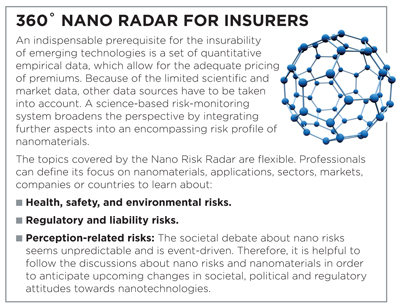
Nevertheless, the Gen Re study states that today most insurance companies do not look into the matter of nano risks at all. Furthermore, the current situation could be called a “waiting period” in the insurance industry. It is recommended that the insurance companies should rather anticipate the potential developments, monitor the ongoing risk research and international regulation with a systematic “Risk-Radar” (refer to the box above).
No Nano Registry In SightNanomaterials are regulated on national and international levels. In the European Union, for example, there are several regulations applicable to nanomaterials. Most of the present regulations on EU level and above do not refer explicitly to nanomaterials or nano-specific properties of the chemicals or products. Many critics and even authorities argue that nanomaterials are not treated adequately in current regulations.

Today there is only one country in the world (France) which has started a mandatory registry for nanomaterials. On the European and also at the global level there is no official registry of nanomaterials and nanoproducts available. A registry of nanomaterials in the European Union has been discussed since 2008 but has never been started. Therefore there is a growing lack of information concerning the use and application of nanomaterials on the market. There is a systematic shortage of data concerning nanomaterials along the value-chain. Downstream users often lack data about nanomaterials which are used in their processes or products. Therefore it seems very difficult for insurance companies to get nano-specific information and data from their insured customers. Thus, liability insurers have to determine the risk profiles in their portfolio with external data and expertise.
In conclusion, liability insurers have to meet the challenges of nanotechnologies. The uncertainties in the risk profile of certain nanomaterials can be handled by:
  • Checking new and existing liability policies in the portfolios for hidden nano risks.
  • Raising customer (external) and underwriter (internal) awareness of potential nano risks.
  • Developing appropriate underwriting strategies with risk-specific signing policies
  • Continuous monitoring, based on the state-of-the-art of science and technology.
Thus, insurers can profit from booming nanotechnologies. They can price their nano policies adequately. On the other hand they can avoid unforeseen late damages and losses through “long-tail” risks of nanomaterials.