Pesquisar este blog

Translate

quarta-feira, 27 de junho de 2012

Campus Party Recife divulga programação oficial


O ativista e fundador do Partido Pirada, Rick Falkvinge, é uma das atrações confirmadas no Palco Principal da Campus Party Recife. Foto: AFP
O ativista e fundador do Partido Pirada, Rick Falkvinge, é uma
das atrações confirmadas no Palco Principal da Campus Party Recife 
Foto: AFP

Foi anunciada a agenda oficial da campus Party Recife, que acontece entre os dias 26 e 30 de julho no Centro de Convenções de Pernambuco e no Chevrolet Hall da capital pernambucana. Serão mais de 200 horas de conteúdos - entre palestras temáticas, mesas, oficinas, concursos e ações especiais - que terão como principais pilares os temas empreendedorismo, inclusão digital, sustentabilidade e inovação.
Nesta edição especial, além do Palco Principal, o evento contará com com quatro palcos temáticos: Galileu, Michelangelo, Pitágoras e Stadium.
"Construímos uma programação que une personalidades internacionais, nacionais e talentos do Nordeste, além de sugestões dos próprios campuseiros através da plataforma online Content Search Investigation (CSI)", explica a gerente de Conteúdos da Futura Networks do Brasil, Carolina De Marchi. "Também ampliamos o leque de temas em relação à edição da Campus Party Brasil realizada neste ano em São Paulo, com maior destaque para a inclusão e a sustentabilidade."
Palco Principal
Cinco palestrantes magistrais já estão confirmados no Palco Principal da edição em Recife.
Mike Comberiate, engenheiro com mais de 40 anos de atuação na NASA, trará pela primeira vez para a Campus Party o Acampamento de Robótica (Robotics Boot Camp) - maratona de desenvolvimento de softwares para robôs.
Bel Pesce, a brasileira prodígio do Vale do Silício, vem compartilhar suas experiências dos anos que passou no Instituto de Tecnologia de Massachusetts (MIT, na sigal em inglês) e sobre sua mais recente empreitada, a startup Lemon.
Julián Ugarte, empreendedor social e design-thinker chileno, falará de sua vivência como fundador do Centro de Inovação da ONG latino-americana Teto.
Rick Falkvinge, ativista e fundador do Partido Pirata, estará pela primeira vez no Brasil durante a Campus Party Recife e apresentará sua trajetória do movimento pirata, além de discutir temas como direitos autorais na era digital e legalização das cópias com cunho não comercial.
Eduardo Kac, bioartista brasileiro, abordará sua experiência como pioneiro da "arte transgênica", espécie de artwork ecológica de plantas e animais fluorescentes verdes, criados através de engenharia genética.
Galileu
Os temas centrais deste espaço serão robótica, modding, hardware, astronomia, nanotecnologia, biohacking, biotecnologia e hack.
O artista e zootecnista Edson Barrus palestrará sobre biohacking, e apresentará o case do Projeto Cão Mulato, que que tem objetivo de criar uma nova raça de cachorro.
O cenário Galileu também abrigará as famosas oficinas de robótica, que sempre são sucesso de público, além de uma mesa sobre a estética da gambiarra e o hacking, o caso pernambucano da luva que faz leitura de LIBRAS, a palestra sobre resfriamento de casemods e terá até lançamento de minifoguetes.
Michelangelo
Música, vídeo, design, fotografia, mídias sociais e blog dominarão o espaço Michelangelo.
Gina Gotthlif, a brasileira responsável pela internacionalização do Tumblr, é um dos destaques do cenário, que terá também o Jovem Nerd entrevistando a palestrante Bel Pesce em um NerdCast ao vivo.
O espaço ainda irá sediar uma mesa com webcelebridades como o paulista Cid (@nao_salvo) e o pernambucano Marcel Dias (@bqeg), a clássica oficina de SEO, um inusitado debate abordando a presença das religiões afro na internet e também um painel para descobrir o que o design centrado no usuário tem a ver com zumbis e naves espaciais.
Pitágoras
Desenvolvimento, software livre, segurança, redes e sistemas operacionais serão a base deste cenário. Silvio Meira, o Chief of Science do C.E.S.A.R, é um dos destaques do ponto.
Atividades como maratonas de desenvolvimento envolvendo HTML5, com destaque para a palestra de Open Web Device ¿ grande novidade que tem tudo para despertar muito interesse dos geeks de plantão, também estão na programação.
A oficina e desafio forense também estarão lá.
E a comunidade Software Livre, poderá interagir ao vivo com o pessoal do Fórum Internacional de Software Livre (FISL), que acontecerá em Porto Alegre (RS) no mesmo período, em uma conferência online.
Stadium
Voltado ao entretenimento digital, os temas centrais deste espaço serão jogos e simulação.
É nele que ocorrerá a Game Jam, maratona de desenvolvimento de jogos realizada em parceria com a IGDA - Recife.
Os campuseiros também aprenderão a criar jogos para Windows 8, transformar sua pequena equipe em uma empresa de jogos e desenvolver games para dispositivos móveis.
Nos painéis de discussão serão abordados temas como o êxodo virtual, a convergência entre cinema, games e a web e ainda uma análise da trilha sonora do Super Mario Bros.
Zona Expo
Área gratuita e aberta ao público em geral, mostrará tendências e novidades apresentadas por grandes marcas do mundo no ramo da tecnologia. Netse espaço também será realizada a ação de Inclusão Digital, que buscará aproximar 3 mil pessoas do universo da tecnologia.
A programação ainda inclui ações especiais como o Campus Fórum, o Green Tech, o Wayra Contest, o Barcamp, ações de Empreendedorismo e a Campus MeetUp, que será inaugurada no Recife.
Mais informações sobre a programação estão no site da Campus Party Recife. Outras atrações poderão ser confirmadas até a data do evento.
Sobre a Campus Party
Criada na Espanha em 1997, atualmente é o maior acontecimento de tecnologia, inovação, ciência, entretenimento e cultura digital do mundo. É um evento itinerante onde os participantes mudam-se com seus computadores, malas e barracas para dentro de uma arena, onde frequentam oficinas, palestras, conferências, competições e atividades de lazer. Em 2008, aconteceu a primeira edição brasileira da Campus Party.
Fonte: Terra

Portugal: armazenamento de energia na base de projetos com China


O ministro da Ciência da República Popular da China apontou hoje a investigação a nível de baterias, armazenamento de energia e sensoriamento através da nanotecnologia como "áreas para projetos conjuntos" entre Portugal e a China.

De visita ao Instituto Ibérico de Nanotecnologia (INL), em Braga, Wang Gang apontou a nanotecnologia como uma "área importante" na cooperação científica com Portugal, depois de segunda-feira os dois países terem estabelecido bases para uma parceria na criação de "uma incubadora" e um centro de transferência de tecnologias.

Segundo o ministro da Ciência português, Nuno Crato, o referido memorando vai ainda "mais longe" ao "criar uma comissão técnica que vai prosseguir e organizar a colaboração entre os dois países e que tem como um dos objetivos fundamentais organizar uma incubadora que permita transformar em valor e iniciativas de valor económico a investigação científica".

Além da nanotecnologia, a bio-medicina, tecnologias de informação e energias renováveis são outras das áreas que o memorando de entendimento entre China e Portugal abrange.

"Já vejo muitas áreas que os dois países podem ter projetos conjuntos e iniciar uma cooperação. Como baterias a nível de nanotecnologia, armazenamento de energia, o sensoriamento com nanotecnologia, novos materiais", apontou Wang Gang.

Segundo Nuno Crato ainda se estão a "identificar projetos", mas uma das possibilidades adiantadas pelo responsável português foi a área de desenvolvimento de "carros elétricos".

Crato lembrou que "já existem projetos comuns" entre os dois países e que a "responsabilidade" dos ministros da Ciência de ambos os países é "desenvolver essas colaborações e dar as maiores possibilidades para que elas apareçam e continuem".

O ministro português esclareceu ainda que esta colaboração está aberta "a todos" os centros de investigação e que o financiamento destas iniciativas é concorrencial.

"Como sempre em ciência as fontes de financiamento são competitivas. Os projetos têm que valer pelo seu mérito. Têm que ser analisados de um ponto de vista da qualidade", afirmou.


ACS hosts Capitol Hill briefing on nanomaterial safety and Toxic Substances Control Act


The American Chemical Society (ACS) Science & the Congress Project invites news media to attend a luncheon briefing on "Nanomaterial Safety: Do We Have the Right Tools?"

It will be held Wednesday, June 27, 12-1:30 p.m., in the Russell Senate Office Building Room 325. To attend, register at http://tinyurl.com/ACSSciCongr-nanoEHS.
This briefing is hosted by the ACS Science & the Congress Project with honorary co-host the Congressional Nanotechnology Caucus.

With nanotechnology, scientists engineer materials on a molecular level; that is, they work with such basic factors as the size, shape and surface properties of substances, in addition to altering the chemical composition, to create materials that exhibit novel properties.

While the science to engineer nanomaterials has been developed largely since the 1980s, public laws to regulate the safety of materials and chemicals, such as the Toxic Substances Control Act (TSCA), were crafted in the 1970s. Important questions for our times: Does our understanding of and information about nanotechnology adequately inform the policies designed to ensure safe product development? Likewise, do the current policies address both the possible problems and benefits associated with nanotechnology? This panel will discuss whether policymakers currently have the necessary tools, both scientific and policy mechanisms, to reap the potentials of nanotechnology.

The briefing will feature the following panelists and an open discussion:
Moderator: Kristen Kulinowski, Ph.D., Science and Technology Policy Institute, Institute for Defense Analyses

Panelists:
  • Lynn Bergeson, Bergeson & Campbell P.C.
  • Richard Denison, Ph.D., Environmental Defense Fund
  • Arturo Keller, Ph.D., University of California, Santa Barbara
###
The ACS Science & the Congress Project was established in 1995 to provide a neutral and credible source of scientific information targeted to policymakers on Capitol Hill. Expert speakers are chosen to provide a balanced presentation about the topic under discussion, and their comments are independent of any position that may be held by the ACS, the sponsors of Science & the Congress or its co-hosts. For more information, click here.

The American Chemical Society is a nonprofit organization chartered by the U.S. Congress. With more than 164,000 members, ACS is the world's largest scientific society and a global leader in providing access to chemistry-related research through its multiple databases, peer-reviewed journals and scientific conferences. Its main offices are in Washington, D.C., and Columbus, Ohio.

To automatically receive news releases from the American Chemical Society, contact newsroom@acs.org.

Fonte: EurekAlert

Gold Nanoparticles are Capable of Unraveling DNA

By Will Soutter

Research carried out at North Carolina State University to identify better methods for genetic material packaging to aid in gene therapy has led to findings that could significantly impact gene therapy research and DNA-based electronics.


Gene therapy is a treatment method for specific medical conditions where the relevant DNA cells are modified. The research team found that DNA’s double helix structure could be unzipped by positively charged gold nanoparticles.

Gold Nano particles pulling on DNA
(Credit:Yaroslava Yingling,
North Carolina State University)
Gold nanoparticles measuring 1.5 nm in diameter were introduced into a solution comprising double stranded DNA. The research team coated the gold nanoparticles with organic molecules that are labeled as ligands. The ligands were either positively charged or hydrophobic. DNA always holds a negative charge. The oppositely charged DNA and gold nanoparticles were attracted to one another to form complex packages. However, the hydrophobic ligands which repel water became enmeshed with each other. This caused the nanoparticles to be pulled into clusters, ultimately unraveling the DNA they were attached to.

Dr. Yaroslava Yingling, co-author of the research paper and assistant professor at North Carolina for materials science and engineering, highlighted the need for customizing the charge, ligands and chemical composition of the materials involved to preserve the structural integrity of DNA. DNA-based electronics is an emerging field that aims to create nano scale electronic circuits by adopting DNA as a template. It involves the process of attaching metal nanoparticles to DNA. The findings from the study serve to caution researchers to thoroughly analyze the properties of the nanoparticles they employ in order to mitigate the risk posed to the DNA’s structural integrity.

Fonte: Azonano

Primer Concurso de Emprendimiento en Nanotecnología

El concurso busca promover nuevos negocios o empresas basados en los resultados de investigación en nanotecnología realizada en las universidades chilenas en las que participen en forma asociada: investigadores, académicos y estudiantes. 

Inscríbete Aquí
 
El Centro para el Desarrollo de la Nanociencia y Nanotecnología (CEDENNA) y el Centro de Innovación y Transferencia Tecnológica, INNOVO de la Universidad de Santiago de Chile, convocan a investigadores, académicos y estudiantes a CREAR EMPRESAS con sus aportes y desarrollos de soluciones o investigaciones propias, en distintas áreas de Nanotecnología, para fortalecer aquellas capacidades que impulsan el desarrollo económico-social y científico-tecnológico de nuestro país.

Ambas instituciones se han unido para apoyar emprendimientos tecnológicos, tomando en cuenta aquellas modalidades que permiten valorizar los resultados de la investigación, entre las que destacan su incorporación en nuevos productos o servicios que posibiliten la creación de empresas o spin-off de base tecnológicas, las que a su vez tienen como factores de éxito: nuevos productos o procesos competitivos, mercados innovadores, conocimiento de los modelos de negocios para incorporarse al mercado y desarrollo de nuevos modelos de negocios para mercados emergentes.

Requisitos del Postulante

a) Podrán participar al primer Concurso Nacional de Emprendimiento en Nanotecnologías, INNOVO-CEDENNA 2012, emprendedores de todo Chile (nacionales y/o extranjeros con residencia definitiva en Chile), sin tope de edad, que posean un proyecto innovador de emprendimiento en nanociencias y nanotecnología, y que aplique a las categorías del concurso.

b) Podrán inscribirse personas jurídicas o naturales, mayores de 18 años al momento de la postulación, de manera individual o como equipo.

c) Los postulantes deben presentarse al concurso con una carta de apoyo o patrocinio de un investigador asociado a CEDENNA.

d) Para postulaciones como equipo, debe designarse a un líder de equipo, quién asumirá la representación del grupo para efectos de comunicación interna. Cualquier cambio producido en los integrantes, deberá ser comunicado expresamente al Centro INNOVO al correo electrónico: emprendimiento@innovo.usach.cl.

e) Las Postulaciones para el primer Concurso Nacional de Emprendimiento en Nanotecnologías, INNOVO-CEDENNA 2012, se realizarán únicamente vía online a través de los sitios web www.innovo.cl y www.cedenna.cl, con fecha y hora límite señaladas en las bases del presente concurso.

f) El participante comprobará su inscripción y recepción del perfil de negocios, a través de respuesta vía mail enviada por la organización del concurso.

g) Cada persona o equipo puede inscribir tan sólo un proyecto por cada una de las categorías del concurso señaladas en las bases del presente concurso.

Premios

El concurso premiará a los perfiles o proyectos ganadores con:

En efectivo: $2.500.000.


Este monto debe ser utilizado en actividades propias a la operación del proyecto y de acuerdos a las actividades financiables de las presentes bases.

Valorados: $2.000.000.

Servicio de Incubación. Potenciamiento del negocio tecnológico (definición, formulación y ejecución del plan de negocios y motivación del espíritu empresarial). Este proceso contempla jornadas de capacitación, tutoría y mentoría realizadas por profesionales y asesores de la Incubadora de Negocios del Centro INNOVO USACH, oportunidad en que el emprendedor y todo el equipo (para proyectos presentados de manera colectiva) deben participar de las jornadas que se planifiquen para este proceso.

Presentación a fuentes de financiamiento públicas y/o privadas. Presentación de la propuesta de negocio a fuentes de financiamiento públicas (InnovaChile de CORFO, Conicyt, FIA, entre otros) y redes de inversionistas ángeles asociadas a la Incubadora de Negocios del Centro INNOVO USACH. (Siempre y cuando el proyecto cumpla con los criterios de presentación y que la madurez del plan de negocio permita su postulación).

Para optar a los premios del Concurso INNOVO-CEDENA, los proyectos deben incubarse de forma exclusiva con la Incubadora de Negocios del Centro INNOVO USACH


Fonte: CEDENNA- Centro para el Desarrollo de la Nanociencia y la Nanotecnología 

Nanoestruturas semicondutoras


Acontece na quarta-feira (27), às 16 horas, o seminário Estudo de nanoestruturas semicondutoras através de ondas acústicas de superfíciena Sala de Seminários José Roberto Leite do Instituto de Física (IF) da USP.

Ele será ministrado pelo professor Odilon D. D. Couto, Instituto de Física Gleb Wataghin da Universidade Estadual de Campinas (Unicamp).
O evento é gratuito e aberto ao público.
O IF fica na Rua do Matão, Travessa R, 187, Cidade Universitária, São Paulo.

Surface defects on silver nanoparticles hold dangers for aquatic life

Researchers at the California NanoSystems Institute (CNSI) and the University of California, Los Angeles (UCLA) have found that the crystal structure of silver nanoparticles is an important determinant of their toxicity to aquatic life. 

The study comes amid growing concern that the proliferation of nanotechnology will result in the inadvertent release of nanomaterials into the environment. Release may occur during the manufacture, disposal, or use of nano-enabled products in consumer or industrial settings. Accumulation of nanomaterials in the environment may produce adverse effects in organisms that are vital for maintaining ecosystem balance. While a great deal of effort has been devoted to studying the toxicity of nanomaterials towards humans, the environmental impact of nanomaterials is less well-understood. 

The toxicity of metal and metal oxide nanomaterials in biological systems generally occurs by either the ‘shedding’ of toxic constituents or by nanomaterial-specific effects. Semiconductor quantum dots, for example, are often composed of heavy metals that can be oxidized and released from the surface as highly toxic ions. Silica nanoparticles, on the other hand, can disrupt the function of biomolecules that they interact with, even though they are composed of constituents that are not particularly toxic. 

In the case of silver nanoparticles, oxidation and release of silver ions was thought to be the primary mechanism by which they pose a hazard to the environment. Silver ions inhibit the Na+/K+ ATPase transporter in the fish gill. This transporter is vital for maintaining sodium and potassium levels in the blood of fish. Its inhibition leads to hypertension, cardiac failure, and death. Ionic silver is also a potent antibacterial agent. While this is a useful property for medical applications, environmental exposure could disrupt the necessary function of bacteria in water and soil. 

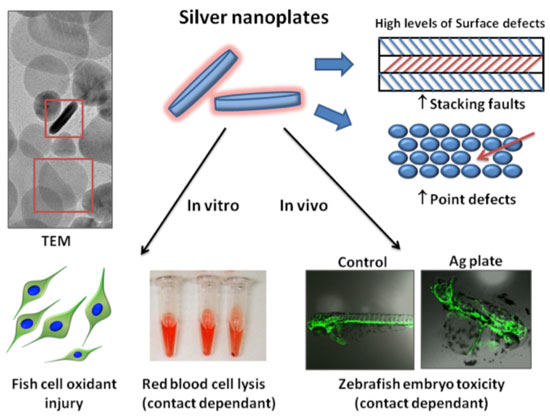
Reporting in the April 6, 2012 online edition of ACS Nano ("Surface Defects on Plate-Shaped Silver Nanoparticles Contribute to Its Hazard Potential in a Fish Gill Cell Line and Zebrafish Embryos"), Dr. André Nel, Director of the CNSI Center for Environmental Implications of Nanotechnology, and his teams at the CNSI and UCLA have added a new dimension to the environmental toxicity of silver nanoparticles. They found that surface defects in the crystal structure of silver nanoparticles can produce toxicity in a fish cell line and zebrafish embryos, independent of silver ion release. These results show that the toxicity of silver nanoparticles to fish is not solely a result of shedding of ionic silver, but may also result from a shape-dependant nanomaterial effect. 


Point defects and stacking faults on the surface of silver nanoplates catalyze the production of reactive oxygen species that damage fish gill epithelial cells, red blood cells, and zebrafish embryos
Point defects and stacking faults on the surface of silver nanoplates catalyze the production of reactive oxygen species that damage fish gill epithelial cells, red blood cells, and zebrafish embryos. (Schematic courtesy of Dr. André Nel)

Nel tells Nanowerk that he credits the discovery to taking an unbiased approach to studying nanomaterial toxicity. “Prior to beginning this study, we did not come in with any preconceived ideas about the toxicity of silver nanoparticles. We weren’t looking for a specific mechanism. We instead considered all possibilities.” 

In other words, they did not look only for evidence of silver ion-mediated toxicity, but instead let the results of their experiments guide them. It was only during the course of the study that the new mechanism became apparent. 
The team egan by examining the toxicity of silver nanospheres, nanorods, and nanoplates in fish gill epithelial cells and zebrafish embryos. All particle morphologies were toxic at high doses. However, when normalized to total mass and surface area, the nanoplates were significantly more toxic than other shapes. 

"The unusually high toxicity of the nanoplates was surprising, and could not be explained solely by silver ion release or enhanced bioavailability of the silver nanoparticles" says Nel.

To look for other explanations, the researchers examined the crystal structure of the different silver nanoparticle morphologies using high resolution electron microscopy. They found that silver nanoplates contained a higher density of surface crystal defects, known as ‘stacking faults’ and ‘point defects’, compared with nanospheres or nanorods. 

Crystal defects occur when the periodic crystalline structure of a material, in this case silver, is interrupted. Atoms at these defect sites tend to be more reactive than those in an equivalent defect-free crystal lattice. Because of their large surface area-to-volume ratio, crystalline nanomaterials tend to have a much higher frequency of defects than bulk materials of the same composition and equal mass. In a biological setting, the reactivity of crystal defects can disrupt biomolecules either by interacting with them directly, or by catalyzing the production of reactive oxygen species (ROS). 

Consistent with the hypothesis that the enhanced surface reactivity of the nanoplates is responsible for their unusually high toxicity, Nel explains that when the nanoplates were separated from cells by a dialysis membrane, toxicity was suppressed. 

"When the nanoparticles were physically separated from the cells, we saw a decrease in toxicity, when they were added back, we saw an increase. This shows that direct interactions between the nanomaterial and cell are necessary for inducing toxicity." 

Toxicity was prevented by pre-treating cells with N-acetyl-cysteine (NAC). NAC is a precursor to glutathione, which is a potent antioxidant that helps to scavenge ROS that accumulate inside cells. During periods of oxidative stress, glutathione may be depleted, exposing cells to oxidant damage. Treating cells with NAC helps to replenish glutathione levels, limiting damage due to ROS over-production. 

Together, these results indicate that the enhanced toxicity of the silver nanoplates compared to other morphologies results from the high density of surface defects that catalyze the production of ROS. 

Although Nel’s study suggests that surface defects can be a major mediator of silver nanoparticle toxicity, it is likely that silver ion release also plays a role. Both processes are likely to occur in parallel. Ultimately, the extent to which each mechanism contributes to toxicity in aquatic organisms will depend on the structure of the silver nanoparticles and how they were produced. 

The results reported in Nel’s study are timely. Over 30% of the roughly 800 nano-enabled products currently on the market contain silver nanoparticles. This means that silver nanoparticles have a greater potential to reach dangerous exposure levels in the environment, compared to other less widely-used nanomaterials. A new set of release and exposure guidelines for silver nanoparticles will have to be developed since the levels defined for ionic silver are not a good comparator. 

There is another important implication of Nel's study. Unlike silver ion toxicity, toxicity resulting from surface defects may not be unique to aquatic organisms. Nel points out that the toxicity from reactive oxygen species can affect mammalian cells as well, suggesting that silver nanoparticles are toxic to a wider range of organisms. However, he cautions that the two systems (mammalian and fish) are not equivalent and historically silver is less toxic in humans than the environment. 

"Toxicity between the two systems is not directly comparable. The presence of physiological proteins, for instance serum proteins, may prevent toxicity by interfering in the impact of surface defects. Each organism must be considered separately. Each will have its own specific mechanisms." 

In mammalian systems, Nel and his team are finding that silver nanowires have yet another mechanism of toxicity that is unique from silver nanospheres and nanoplates. Details of this aspect-related mechanism of toxicity will be published in an upcoming article. 

In extrapolating the results beyond silver nanoparticles, Nel believes that toxicity resulting from surface-reactive crystal defects may apply in general to crystalline nanomaterials. 

"Surface defects are an evolving paradigm of nanomaterial toxicity, not only for silver but also for other materials with reactive surfaces. For instance surface reconstruction could play an important role in transducing the toxicity of material like quartz or some types of silica." 

Along with assessing the toxic potential of nanoparticles, Nel and his team are also searching for ways to mitigate toxicity by developing ‘safe-by-design’ strategies that are premised on specific material properties. 
"There are currently three ways that we have identified to mitigate the toxicity of nanomaterials: 1) covering surface defects with small molecules, 2) doping soluble materials to prevent dissolution of toxic constituents, and 3) using surfactants to prevent the interaction of nanomaterials with biomolecules." 

In the case of silver nanoparticles, Nel found that by incubating particles with the amino acid cysteine, the toxicity of all tested morphologies could be significantly diminished. Cysteine can coordinate to metals through a thiol group which chemically passivates reactive sites. This offers a potential route by which silver nanoparticles could be detoxified prior to environmental release. 

Nel points out that a balance must be struck between suppressing nanomaterial toxicity and maintaining desirable properties. 

"Modifications may also eliminate some of the desirable properties of nanoparticles. Treating silver nanoplates with cysteine, for example, may prevent toxicity but could also compromise their utility as catalysts. Finding a compromise means that we understand exactly what makes a material hazardous and what gives it desirable properties." 

The strategies that Nel and his team used to elucidate the mechanisms of silver nanoparticle toxicity in this study are being adapted to rapidly screen for the toxicity of other nanomaterials. 

"Classical toxicology was based on descriptive characterization, rather than mining all of the possibilities. High throughput systems allow us to identify all of the possibilities that may hold true at the nano-bio interface. We have implemented a discovery platform that shows us the possibility of many different potential outcomes. You may find that there is a lot more going on than you originally thought if you use the right discovery tools." 

In the future, strategies that enable the rapid screening of the toxicological potential of nanomaterials prior to large-scale development will allow one to develop nano-enabled products that are effective, but also safe for humans and the environment. Until then, this study reminds us that caution must be exercised on by all participants in the nanomaterial development pipeline, including researchers, manufacturers, and consumers. 

By Carl Walkey, Integrated Nanotechnology & Biomedical Sciences Laboratory, University of Toronto, Canada. 


Fonte: Nanowerk

terça-feira, 26 de junho de 2012

EU-OSHA Publishes Literature Review on Nanomaterial Risks


There are serious gaps in our awareness of the potential risks involved in handling nanomaterials at work, and serious shortcomings in the way that those risks are communicated to workplaces, according to a new literature review from the European Agency for Safety and Health at Work (EU-OSHA).


We are facing nanotechnology in our everyday life in many products and applications. Although health and environmental hazards have been demonstrated for some manufactured nanomaterials, they are used in food, cosmetics, textiles, paints, sporting goods, electronics, detergents, and many health and fitness products.

And they are present in many workplaces, too. Currently, there are over 1,000 consumer products listed, produced by more than 500 companies in 30 countries. 300,000 to 400,000 jobs in the EU deal directly with nanotechnology and manufactured nanomaterials are handled in many more workplaces down the supply chain
; 75% of them are small and medium-sized enterprises.

In its review of current research on the subject, EU-OSHA found that communication of the potential risks posed by such materials is still poor, with a majority of Europeans (54%), not even knowing what nanotechnology is. Even in workplaces where manufactured nanomaterials are found, the level of awareness is low. For example, 75% of workers and employers in construction are not aware they work with them.

There are some initiatives to communicate the risks of manufactured nanomaterials and how to manage these (though not always targeted at the workplace), for example by major producers, some trade unions, national dialogues within some Member States, and Europe-wide through the Communication Roadmap by the European Commission.

But much more still needs to be done (preferably jointly by policymakers, the social partners, national occupational safety and health bodies, public health agencies, sectoral associations, etc.) as poor risk communication may generate confusion and lead to unjustified fears or to underestimation of the risks, with consequent inadequate risk prevention and control. Risk communication strategies need to help employers make informed decisions about their workplaces and put adequate prevention measures in place, and to empower individual workers to take personal control of their own situations in order to protect themselves adequately.

EU-OSHA has developed an on-line database of company Good Practice examples of good workplace management of manufactured nanomaterials which covers eight Member States and a variety of industries such as textile, construction and medical applications. Future work on the topic includes a web feature and short and practical information material on risk management tools for nanomaterials and for risk management of nanomaterials in maintenance, construction and health care.

Source: European Agency for Safety and Health at Work (OSHA)

Download the complete report here (pdf; 1 MB)

Online presentation about risk communication of engineered nanomaterials: Link

Further information: info@innovationsgesellschaft.ch

EU: NanoSustain Project


"Development of sustainable solutions for nanotechnology-based products based on hazard characterization and LCA"
Although production of nano-materials is rapidly increasing, our knowledge about possible health and environmental effects associated with these materials is still rather poor. This lack of knowledge calls for more research. Due to their small size, nano-particles behave differently to their chemical analogues. They can be taken up easily and in a unique way with possible adverse effects in man and organisms. Assessing their hazard is complex and needs new approaches coupled with close international cooperation. NanoSustain will address these questions.

Expected Results

Expected results will improve our present knowledge on the impact and fate of these particles after entering economic and natural cycles. NanoSustain has mobilized the critical mass of expertise, resources and skills to tackle this complex issue.
Based on results from hazard characterization, impact assessment and LCA, we will explore on a lab-scale new solutions for the design of selected nano-materials and associated products and their sustainable use, recycling and final treatment. As the concerned nanotech industry will actively participate in the planned project, NanoSustain will set the ground for the development of new sustainable products and industrial applications, and hence help to strengthen competitiveness of the European nanotechnology industry.

EU: NanoValid Project


NanoValid
The EU FP7 large-scale integrating project NanoValid (contract: 263147) has been launched on the 1st of November 2011, as one of the "flagship" nanosafety projects.

The project consists of 24 European partners from 14 different countries and 6 partners from Brazil, Canada, India and the US and will run from 2011 to 2015, with a total budget of more than 13 mio EUR (EC contribution 9.6 mio EUR). Main objective of NanoValid is to develop a set of reliable reference methods and materials for the fabrication, physicochemical (pc) characterization, hazard identification and exposure assessment of engineered nanomaterials (EN), including methods for dispersion control and labelling of ENs. Based on newly established reference methods, current approaches and strategies for risk and life cycle assessment will be improved, modified and further developed, and their feasibility assessed by means of practical case studies.
In cooperation with other relevant projects, such as MARINA and QNano, and relevant standardization bodies, such as the OECD WPMN, existing industrial or newly designed ENs will be subjected to a rigid and comprehensive inter-laboratory validation campaign that includes the currently most advanced methods and instruments for measuring and characterizing of ENs, to generate accurate and reproducible material data and standardized method protocols, also for tracing and quantifying nanoparticles (NP) in complex matrices. The stability and behaviour of selected NP will be monitored and tested in a variety of relevant environmental samples and test media to derive optimum and reproducible fabrication, measurement and test conditions.
The validated characterization methods will be used to design well-defined certified reference materials, which in turn will help to validate, adapt, modify and further develop current biological approaches (in vitro, in vivo and in silico) for assessing hazard and exposure of ENs, and associated risks to human health and the environment. Effects of chronic and accumulative exposure and of exposure under real-life conditions, where ENPs are likely to act as components of complex mixtures, will be duly taken into account.
NanoValid mapa parceiro
The NanoValid consortium consists of 29 partners and 2 cooperating partners from 19 countries.
Fonte: NanoValid